Genomic Analysis II - Coalescent and Genetic Diversity
Macro vs Microevolutionary processes
- Macro are large scale long term changes like speciation
- Microevolutioanry processes refers to variation within a population - this is the focus of population genomics
Example: Saimaa ringed seal genomes
- Using the Saimaa seals from different populations and their genomic data, they can estimate the Effective Population Size in the past going back generations
- Study
Population Genetics and Phenotypes
- Before DNA sequencing, people like Mendel relied on observing phenotypic traits
- Since the 70s and especially since technological advances in the 90s we can measure allele frequencies and really get into things
DNA recap
- Basic DNA stuff
Genomic Locus
- A location in the genome we are studying - this can be one base-pair, 7 base pairs, or 30,000 - the scale depends on the question we are asking
Allele
- An allele is a variant of a locus.
- A bi-allelic locus has two possible types
- Alleles changing can affect the phenotype but usually they don't
Site
- A single nucleotide
Parentesis
- Why are most mutations non-coding?
- It's because of codon usage bias - part of the "Central Dogma of molecular biology"
- Each time an amino acid is produced, it is made by a 3-nucleotide sequence of bases called a codon
- However, many codon sequences code for the same amino acid. So often a mutation that changes a single base pair might not even change the produced amino acid
Types of genetic variation
Substitutions
- Synonymous - no amino acid replacement
(In mammals:...
COmplete this
Small scale structural variation
- Single nucleotide polymorphism (SNPs)
- This is where you compare two loci with one different substituted base pair
- These are the most often studied since they are easiest to study
- Deletions, insertions (Indels)
- These are harder to study
Large scale structural variation
- Chromosomal duplication
- This is what happens with Trisomy conditions (down syndrome) in humans
- Genome duplication
- In salmonids, whole-genome duplication occured in an ancestor so they all have double genomes: Study
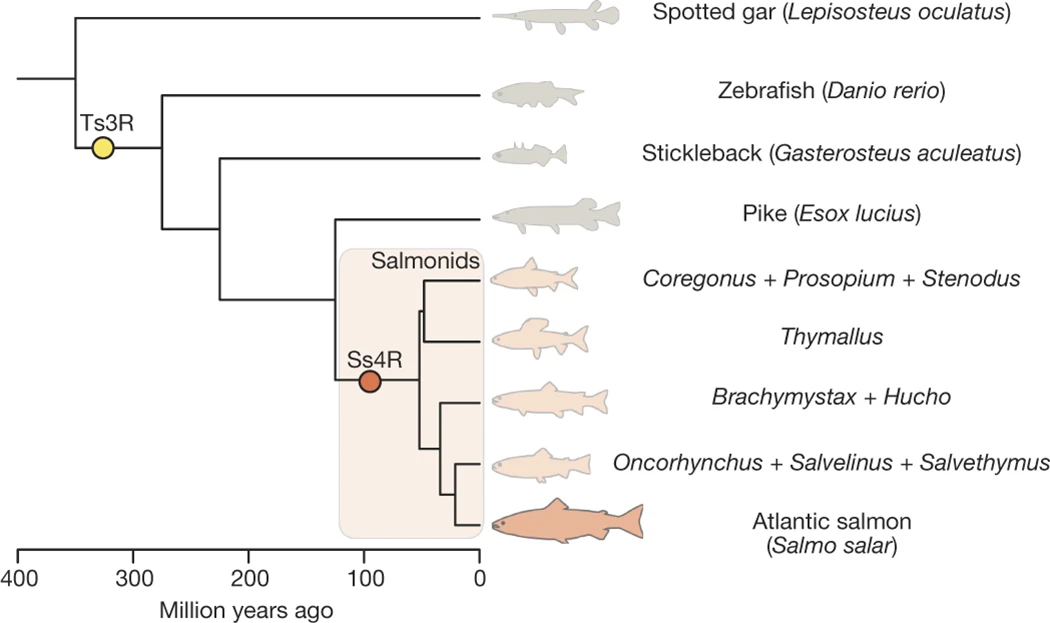
- In salmonids, whole-genome duplication occured in an ancestor so they all have double genomes: Study
Trajectories of different mutations
Recap of Population Genetics - Selection
- Selection is driven by environmental conditions
- Drift is a random effect and can cause alleles to dissapear from the population or become fixed - this effect is stronger in smaller populations
- Population bottlenecks reduce overall genetic diversity (the founder effect)
Testing hypotheses of evolution
- We can use the Infinite-SItes Model (IFM)
- infinite number of sites where mutations can occur
- Every new mutation occurs at a novel site
- There is no recombination or reverse mutations
- Based on these assumptions, if two alleles share a mutation at a particular site, they must derive from a common ancestor allele, so they must be related at a certain time.
- This model can help us reconstruct
Coalescence theory
Theoretical example
- The entire human population is reduced to 10 males and 10 females
- Two generations later, regardless of the population size, everyone has the same probability of sharing a grandparent
- 1/10 chance ofsharing grandmother (1/16th of their genes)
- 1/100 chance of sharing both grandparents (1/8 of genes)
- So, based on the genomics of the current population, we can determine based on the amount of relatedness how many grandparents there were at the start
Coalescent
The coalescent is the structure that summarises genetic inheritance:
- Describes relatedness as inheritance.
We can build a phylgenetic tree for each gene - because of recombination they might not recombine the same way each time
Two individuals that share the same pedigree can have different genes
Each node on a phylogenetic gene tree represents a "coalescence event" that shows where two lineages shared a common ancestor - happens at a certain generation.
The shape of a coalescent tree encodes demographic history - many coalescent events in one generation represents a bottleneck (the branches are short and close)
- From our example from earlier - the ten grandmothers would have a lot of coalescence - their ancestors were all not very related to each other but their children all share more genes.
Coalescence and mutations
Mutations accumulate randomly in the tree- long branches will carry more mutations than short ones, patterns of genetic variation give us clues aboutgenetic history
- In an expanding population, we seealot of mutations in a similar lineage - we call these "singletons"
- In a decreasing population we see lots of coalescent events at the end
Site frequency spectrum
- My counting the number of mutant alleles (different from reference genome) we have in each position in the different individuals, we get the allele frequency
Summary Statistics
Site frequency spectrum
- This one is very important for the practical
- A histogram showing the distribution of allele frequencies
- A recently expanding population will have an excess of rare mutations
Tajima's D test
A statistic dest that measures the distance (
is neutrality - population is at equilibrium, no selection : There is an excess of rare alleles in the population - This is evidence of positive selection and/or population expansion after a recent bottleneck
means balancing selection and/or sudden population contraction
Nucleotide diversity (
- Assesses genetic variation at nucleotide level - average number of nucleotide differences per site
- Populations that recently had a genetic bottleneck will have less nucleotide diversity