Four-Question Framework
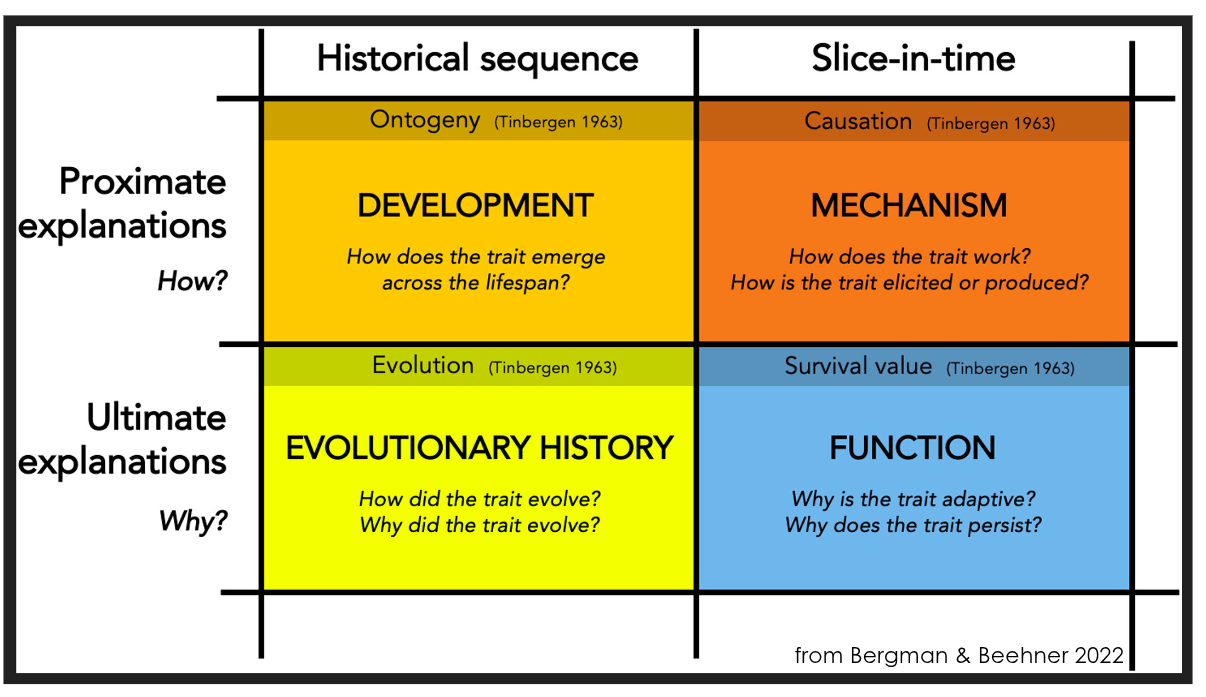
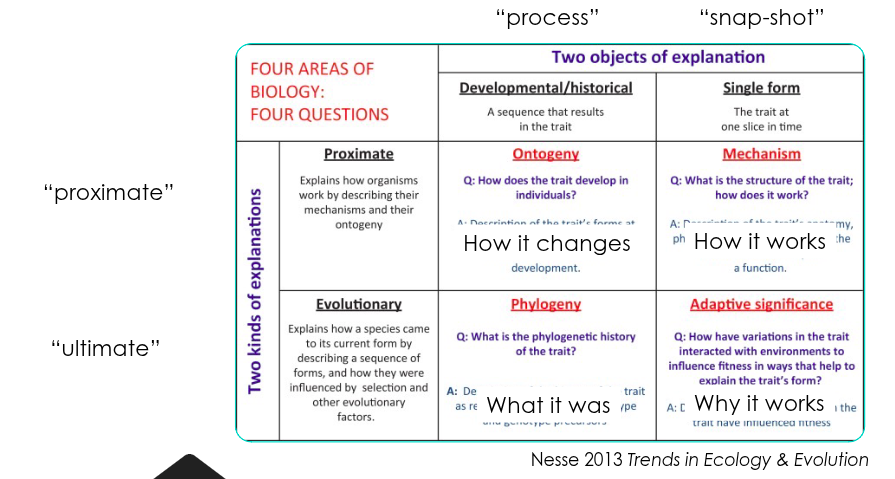
"Why" questions can be answered in four ways:
Proximate Explanation
These are more mechanistic and explain how something gets there
1) Causation
- In terms of causation or mechanism. Starlings sing because the increasing length of day triggers changes in their hormones, or because of the way air flows through the vocal apparatus and sets up membrane vibrations. These are answers about the mechanisms that cause starlings to sing, including sensory and nervous systems, hormonal mechanisms and skeletal–muscular control.
2) Development
- In terms of development or ontogeny. For example, starlings sing because they have learned the songs from their parents and neighbours, and have a genetic disposition to learn the song of their own species. This answer is concerned with genetic and developmental mechanisms.
Ultimate Explanation
These are more about adaptive advantage and tell more about evolution.
3) Function
- In terms of adaptive advantage/significanfce or function. Starlings sing to attract mates for breeding, and so singing increases the reproductive success of males. Related to the concept of Functional Traits - this is a way of categorizing an organism based on its evolutionary function
4) Phylogeny
- In terms of evolutionary history or phylogeny. This answer would be about how song had evolved in starlings from their avian ancestors. The most primitive living birds make very simple sounds, so it is reasonable to assume that the complex songs of starlings and other song birds have evolved from simpler ancestral calls.
Table Display (way of categorizing this)
Lion Example
Synchronous oestrus within a pride
- Causal explanation - influence of pheremones
- Functional explanation (adaptive advantage) - cubs born synchronously survive better due to communal suckling, also higher chance of males having a similar-age companion from the same pride, which will help them take over other prides.